This program has expired. To find upcoming programs happening in your area, see the Explore page
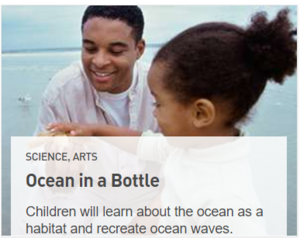
Ocean in a Bottle
PNC
Objective:
Children will learn about the movement of the ocean by using a variety of materials to recreate ocean waves to explore the ocean habitat.
What You Will Need
- 16 ounce plastic water bottles – one for each child
- Blue food coloring – 2 bottles
- Baby oil or vegetable oil – ½ cup for each child
- Measuring cup with spout
- Funnel
- Tiny shells – a handful for each child
- Sparkles
- Glitter
- Hot glue gun (for adult use only)
- Thin tip permanent marker
- Water
What To Do
- Write each child’s name on the lid of their bottle with the permanent marker.
- Using the funnel and measuring cup, help each of the children fill their bottle two-thirds full of water.
- Let each child add a few drops of the food coloring to the water in their bottle.
- Provide the children with the assorted shells, glitter, or other sea-related trinkets. Show them how to put the items into the bottle.
- Using the measuring cup and funnel again, help the children add some oil to their bottles (filling the bottle to within about one-half inch of the rim).
- Glue the bottles shut with the hot glue gun and let cool.
- When the bottles are cool, give them back to the children. Tell the class that, if they tip the bottle, it will look like rolling ocean waves.
Guiding Student Inquiry
- What do we know about the ocean? What do we know about ocean waves?
- Describe waves. What do the waves do in the ocean?
- Look at the water and the oil. How are they alike? How are they different?
- How can we make the water light blue? How can we make the water a darker blue?
- What happens to the oil and water when you shake the bottle?
- The ocean is a habitat. Can you name some animals or plants that live in the ocean?
- How do animals live in the ocean? What do they eat?
Explore, Extend & Integrate
- Read the digital storybook, Grover’s Underwater Hugs. Grover is in need of some hugs, so Elmo tells Grover about a good underwater hugger. Grover goes for a ride under the water in his trusty submarine. Grover sees lots of underwater life as he searches for an eight-armed underwater hugger. Go to Reading Adventures, a series of five Sesame Street digital storybooks focused on vocabulary development and choose Grover’s Underwater Hugs.
- Create colored sea salt for an art activity or your art center.
- You will need quart-size re-sealable bags (one for each color), sea salt, food coloring, aluminum foil, white card stock, liquid glue, small paper plates, and paintbrushes.
- Place approximately one cup of salt in each sealable bag and add a few drops of food coloring.
- Shake each bag to evenly distribute the food coloring and dye the salt.
- Pour the contents of each bag of salt onto a piece of aluminum foil to dry.
- When the salt is dry, the children can use the paintbrushes to spread the glue onto the card stock and sprinkle the colored salt onto the paper to create pictures.
- Transform your water and/or sand table into an ocean. Include ocean animals and have the children name the animals. Make tides in the water table.
Check for Children's Understanding
- Was each child able to create an “ocean” in their bottle and recognize that it represents the movement of the waves in the ocean?
- Can children explain what happens with the water in waves?
-------------------------------------------------------------------------------------------------------------------------------------------------------------
This program is made available through the PNC Grow Up Great program. Designed for teachers to use flexibly with existing curricula, we collaborated with our grant partners to develop resources and lessons to enhance hands-on learning for young children. Check out more lessons from PNC Grow Up Great.
Age: 3—6
Cost: FREE
Type: Online